Artigo muito enriquecedor publicado no “the War Illustrated”, de 9 de dezembro de 1916. Na opinião do autor, o tanque “não vinha para ficar”…
‘Cruising in a Tank’
by Max Pemberton
It is evident that the “tank” has not come to stay. It is here to go on. When it first burst upon the astonished Germans like a dragon upon children from a wood of fables our critics were a little doubtful about its future. “It is experimental,” they said. “Famous things have been done, but we do not know how far it will go.” Well, it has gone a long way already, and we may say in all moderation that it has but begun.
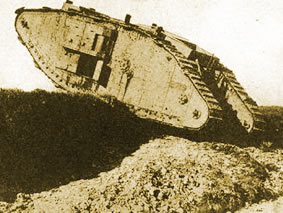
O começo...
There have been new things in this war—as perhaps in all wars—but the “tank” was both a new and à humorous thing. When Hannibal introduced the Roman to the elephant there may have been laughter in Carthage, but no historian has recorded it. Gunpowder about the time of Crécy does not appear to have inspired the Harry Tates of the time. The first man in armour may have amused his relatives at home, .and no doubt the small boy of the period had observations to make upon his appearance. For all that, the man in armour is ever historically a gentle knight sans peur et sans reproche. Even throwing back to the East and the coming of the Juggernaut, it has needed a twentieth- century artist to hitch laughter to that singular coach. Yet I suppose the Juggernaut is the true forbear of the “tank.”
Some people will tell you that it all arose from the employment, both by us and the Germans, of the armoured car at the beginning of the war. We put machine-guns upon fine Rolls-Royce chassis, sent them into France and Flanders, and often left them in a few weeks hut rusted wrecks upon a roadside. They were not new, for, oddly enough, in the very earliest days of the motor movement inventors came forward with contraptions of the kind; and so closely did they resemble the machines which fought in Flanders that one must look twice at the picture to discover their lack of modernity. Continuar lendo